SHEV: Underground car parks
Underground car parks require effective ventilation to maintain air quality during daily operation and manage smoke and heat in the event of a fire.
At Altenova, we design and install tailored ventilation systems that combine efficient air circulation with controlled smoke and heat extraction. Using strategically positioned impulse fans, air supply points and extraction shafts, our solutions support everyday safety, evacuation and firefighting operations.
Daily ventilation
Daily ventilation helps maintain air quality in underground car parks by removing vehicle emissions and ensuring effective air circulation throughout the facility.
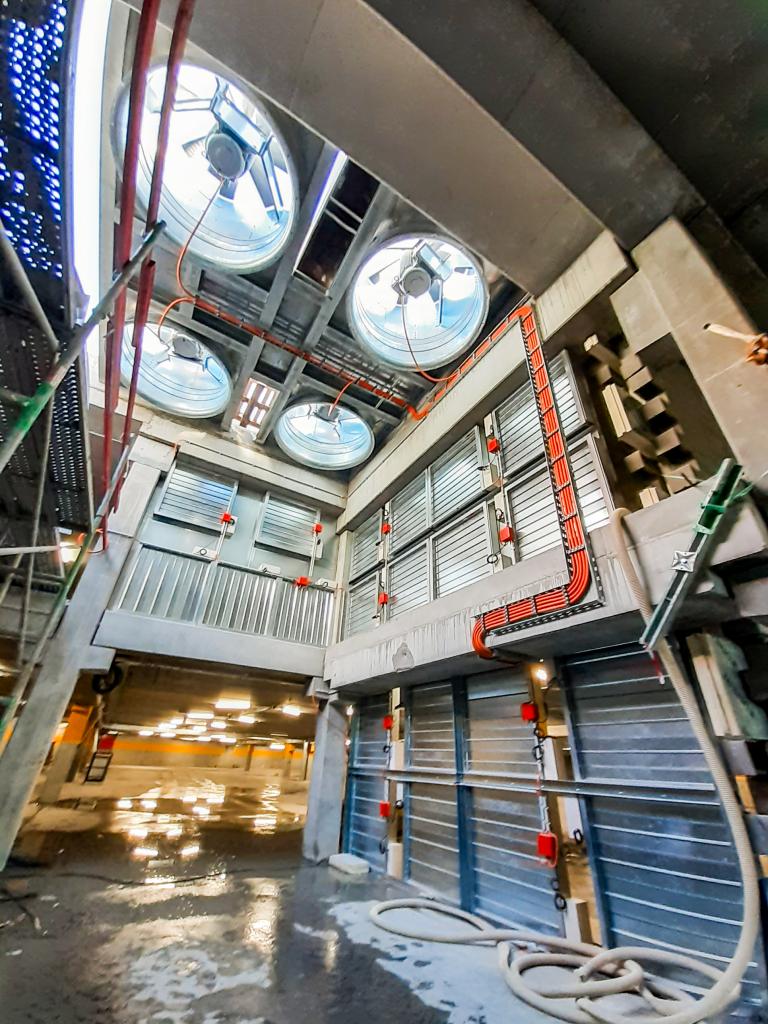
Ceiling-mounted impulse fans work together with air supply and extraction systems to create controlled airflow, including in areas where natural ventilation is limited.
The system can be connected to carbon monoxide (CO) and nitrogen dioxide (NO₂) detectors, depending on the project's requirements. Ventilation capacity is automatically adjusted according to measured pollutant concentrations, increasing airflow when required to maintain acceptable air quality.
Smoke and heat extraction
In the event of a vehicle fire, the SHEVS helps control the movement of smoke and hot gases, limiting their spread and supporting firefighting operations.
The system uses strategically positioned air supply and extraction points together with impulse fans. While some equipment may also serve daily ventilation, fire mode operates according to predefined scenarios, based on the location of the detected fire.
Using aerodynamic principles, the system directs smoke towards designated extraction points and can create virtual smoke compartments to help contain smoke within defined areas. Fan operation and airflow are carefully calculated to support effective smoke control and improve access for firefighters.
The system is activated through fire detection and control equipment, with its operation adapted to the parking facility's layout and fire safety requirements.
Benefits
- Improved air quality: Effective removal of vehicle emissions and controlled air circulation throughout the parking facility.
- Efficient use of space: Reduced need for extensive ductwork, allowing greater flexibility in the building's layout.
- Targeted smoke control: Controlled airflow helps direct smoke and heat towards designated extraction points during a fire.
- Support for evacuation: Smoke management can help maintain more tenable conditions along designated escape routes, depending on the system design and fire scenario.
- Improved firefighting access: Supports emergency services by limiting smoke spread and improving access to affected areas.
- Reduced fire impact: Helps limit smoke spread and heat exposure, potentially reducing damage to the building and its infrastructure.
CFD simulation
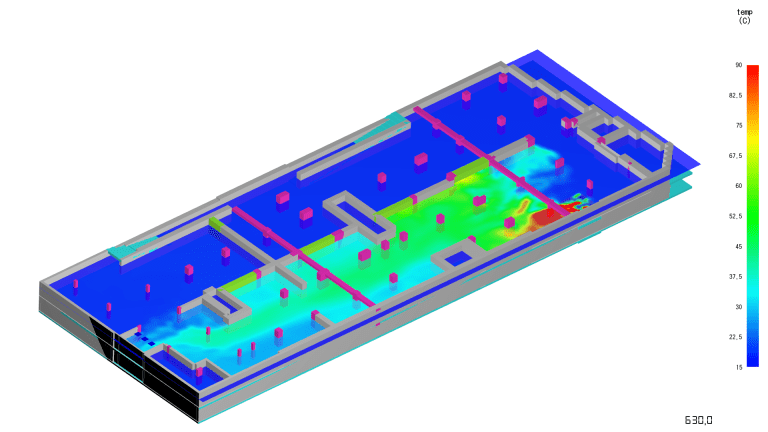
Computational fluid dynamics (CFD) simulation is used to analyse airflow and assess smoke and heat movement in underground car parks during a fire.
A detailed three-dimensional model incorporates the parking facility's layout, ventilation equipment and defined fire scenarios. The simulation evaluates airflow patterns, smoke movement, temperatures and visibility over time.
The results help our specialists optimise the ventilation system design and evaluate its performance against relevant fire safety objectives and design criteria.